Showing posts with label archaeology. Show all posts

Saturday, September 6, 2014

Le Dolmen de la Pierre-Pèse, Limolonges, France, late August

The roadside sign that marked the path was small and low to the ground. I walked away from the intense sound of vehicles whizzing past, their weight and power all too evident on a narrow road with no really safe space for pedestrians, into a moss and ivy hung oak wood full of birdsong. From the moment I entered it was obvious that this was no ordinary place, and then the dolmen came into view, so perfect and magical it literally took my breath away.

Once a tumulus covered with an earthen mound that has since vanished, le Dolmen de la Pierre-Pèse is a megalithic monument that has stood for perhaps five thousand years in the French countryside. An early archaeological exploration here in the first years of the 19th century turned up many human bone fragments, confirming the dolmen's use as a burial site in Neolithic times. In the not too distant past folk beliefs throughout Europe connected dolmens and other megalithic monuments with the faery realm. Whilst visiting this site one could very easily be convinced that there is truth in these tales... 

I discovered this small bird of prey dead nearby and carried it inside the dolmen as a fitting place of rest.
                                                                           ***
And from this site I brought home with me a small clump of moss, two bright crimson hawthorne berries and two brindled feathers that lay on the ground

Wednesday, January 9, 2013

Travels in Turkey

Wishing you all a happy and creative New Year filled with good things! It's been a long time since my last post--more than four months. To make up for my incredible laziness I'd like to share some photos from my recent trip to Turkey...a magical land with a winning combination of sea, mountains, a rich ancient history, lovely handcrafts and charming villages.

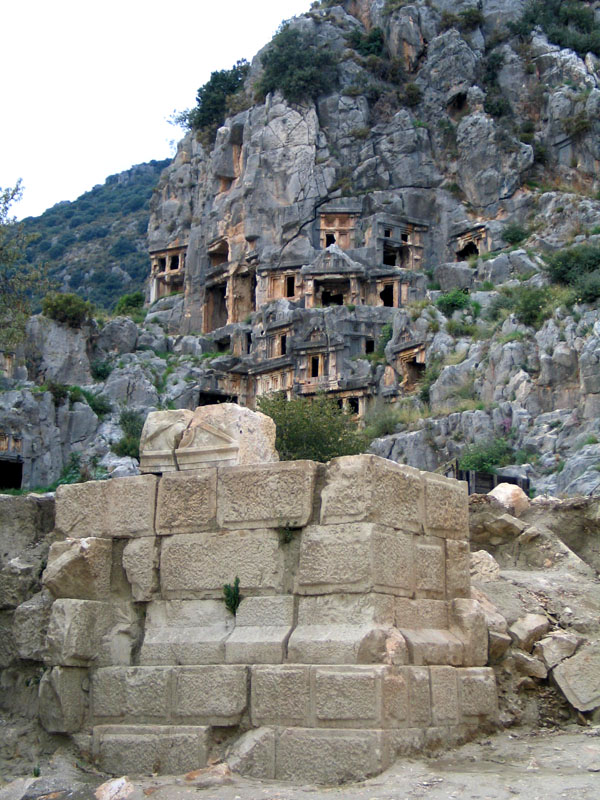
The photos in this post are from the site of the ancient Lycian city of Myra. Much there has been leveled by earthquakes over the more than two thousand years since the city was built but it still possesses the bulk of a fine stone amphitheatre and a beautiful collection of rock cut tombs carved out of the cliff face that towers over the site. There are also row upon row of carved stones from other buildings which are no longer standing. The intriguing bas relief faces and decorative motifs on these must have kept a small army of stone carvers busy over many years...

 Carved stone building parts, Myra, Turkey

More carved stones from fallen buildings

View of Myra's amphitheatre and the cliff with rock cut tombs behind it

Stone garland and figures

More beautiful decorative stone

Amphitheatre entrance

A rubble filled stairway in the amphitheatre

A bit of "out of character" carving on a building stone--maybe an example of ancient stone carver's graffiti?

A fallen lintel in the amphitheatre

More decorative carving

A tomb entrance

Rock cut tombs

Another tomb entrance

Virtuosity in stone

Tombs carved from solid rock in the cliff face more than two thousand years ago
Another entrance to the amphitheatre   


Overview of the largest cluster of rupestrian tombs    

Part of the amphitheatre


Some tombs are nearly free standing but still firmly rooted in the rock from which they were carved.

Monday, January 17, 2011

Paleolitic Fae?

If you've ever been curious about how early faeries lived whilst our ancestors were dwelling in caves and wrapping themselves in animal skins I'd like to take you on a short photographic visit to this recently discovered miniature troglodytic habitation, the first of its kind to be acknowledged and systematically studied by the scientific community. The cave site has been described by investigating scholars (in distinctly nonacademic terms) as "tiny--about the size of a large washbasin" and was discovered in the autumn of 2010 by a pair of recreational rock climbers whose Sunday outing dislodged the stones blocking the entrance. The actual location is a closely guarded secret and has been described by the press simply as "a steep cliff face in the Dordogne, France", a region already famous for its many traces of early cave dwelling humans. 
Although at this point in time there can be little more than educated conjecture concerning the original purpose of this amazing site, judging by the extensive wall decor and rich furnishings it appears to have been a place of some ritual or ceremonial importance. (In some aspects it also bears a striking if rather anachronistic resemblance to photos of mid twentieth century art galleries of the abstract expressionist persuasion--notice in particular the small sculptural pieces on pedestals). Whatever its original purpose, it is a stunningly well preserved glimpse into the distant magical past and yet another cautionary note to the fae naysayers.